


Gold SIP vs Lump Sum: A Simple Guide to Choosing
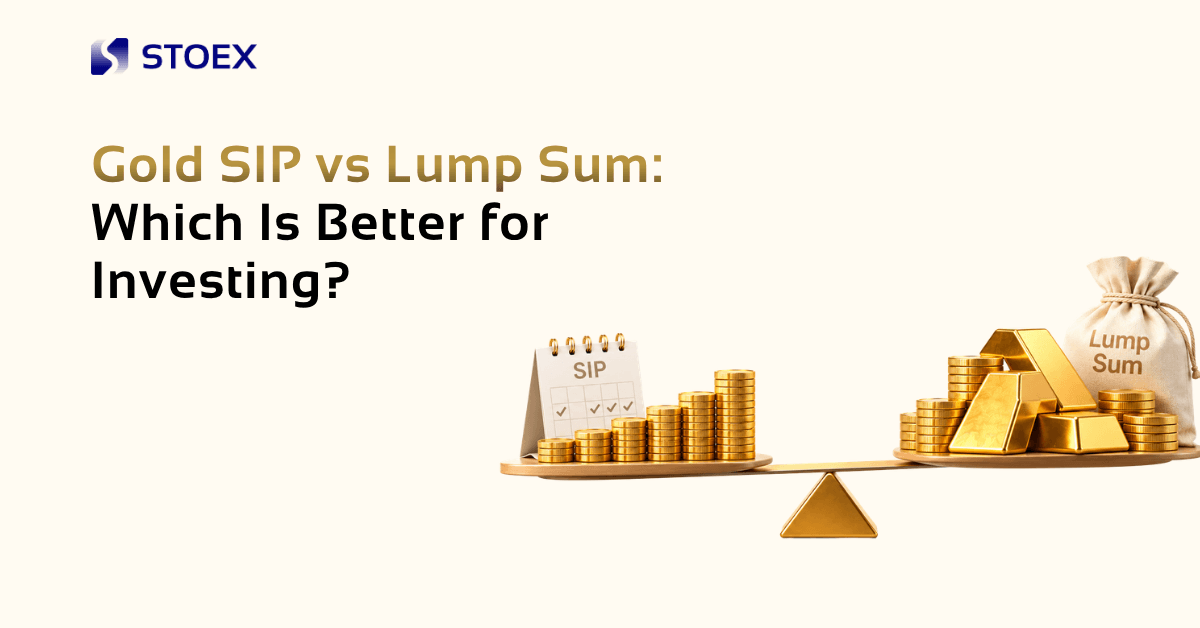
In the gold SIP vs lump sum investment decision, a SIP spreads your purchases across months, while a lump sum gives you full exposure to gold from day one. A SIP can suit regular monthly investing, while a lump sum may work better when you already have money set aside. Neither guarantees better gold SIP returns or lump-sum returns, so your cash flow, investment horizon, costs and risk tolerance matter.
Gold ETFs saw investors pull out ₹725 crore in May 2026. A month later, they put in ₹3,443 crore. Same asset. Two very different decisions.
That’s why the gold SIP vs lump sum decision isn’t simply about which one gives better returns. It’s also about how you want to deal with gold price volatility. A gold SIP investment spreads your purchases across different prices, while a gold lump sum investment puts the full amount to work immediately.
If you have ₹60,000 to invest, should you buy gold worth ₹60,000 today or spread it across 12 months? Let’s look at what changes, what doesn’t, and when each approach can make sense.
Gold SIP vs Lump Sum: What’s the Difference?
A gold SIP is a form of systematic investment: you put a fixed amount into gold at regular intervals, say ₹5,000 every month. A lump sum investment is a one-time investment of a larger amount, such as the ₹60,000 you just received as a bonus.
But there’s an important distinction here: SIP describes how you invest, not what you invest in. A monthly gold investment could mean recurring purchases of digital gold or a SIP in a gold mutual fund, while some platforms may also support recurring purchases of Gold ETFs. Each product has its own structure, charges, liquidity and tax treatment.
So, the gold SIP vs lump sum choice determines how your money enters the market. The product determines what you own, what it costs and what protections apply. You need to look at both.
| Factor | Gold SIP | Lump sum |
|---|---|---|
| How money goes in | Fixed amount at regular intervals | One larger amount in a single transaction |
| Entry price | Spread across many purchase dates through rupee cost averaging | One purchase price on one date |
| Exposure to gold prices | Builds up gradually | Full from day one |
| Cash flow | Comes from monthly surplus | Needs a ready corpus |
| Timing pressure | Lower, since no single date carries the decision | Higher, since one decision carries everything |
| Tends to suit | Regular earners building a gold investment plan over time | Money already earmarked for a lump sum gold investment |
Neither approach removes gold price risk, and neither changes what the product charges you. Those two things stay the same either way.
When Can a Gold SIP Make More Sense?
A gold SIP can fit more naturally when:
- You earn regularly. If your money arrives as a monthly salary, a monthly gold investment lets you invest from your surplus instead of waiting to build a large corpus.
- You don’t want to make one big timing call. Nobody knows exactly when gold will be at its lowest. Spreading purchases across months is the basic idea behind rupee cost averaging: the same amount buys more gold when prices are lower and less when they are higher.
- You want a habit rather than a monthly decision. The appeal of a SIP is partly behavioural. Once the amount and frequency are set, you don’t have to decide whether to invest every time gold moves. That’s one reason regular investing has become so common: SIP inflows into mutual funds hit ₹32,297 crore in August 2026, according to industry data.
- You’re building your gold allocation gradually. If gold is one part of a wider portfolio, regular purchases can help you build that allocation without committing a large amount on one date. As STOEX CEO Sudeep Chatterjee has noted, the often-cited 5–15% gold allocation is not a fixed rule; the right allocation depends on your goals and risk appetite
But what if gold prices fall after you start?
This is where gold SIP benefits can be misunderstood. If gold falls, your next instalments buy more gold for the same amount. But that does not mean your investment is protected from losses. If gold keeps falling for a prolonged period, your holdings can still lose value.
In other words, a SIP helps spread market timing risk. It does not remove gold SIP risks, and it cannot guarantee better gold SIP returns.
When Can a Lump-Sum Gold Investment Make More Sense?
Sometimes, you don’t need to spread the investment out. A lump sum is a one-time decision; it tends to fit when:
- The money is already earmarked for gold, a bonus, a maturity payout or savings you’ve set aside for this purpose.
- You’ve decided how much gold belongs in your portfolio. That decision should come from your overall gold allocation and portfolio diversification goals, rather than from trying to guess this week’s gold price.
- You accept that the whole amount is exposed immediately. Your full amount is exposed to gold price movements from day one.
- You can sit through the swings. If you may need to sell quickly, a lump-sum investment
A Simple Example: Investing ₹60,000 in Gold
Let’s make the difference concrete. You have ₹60,000 for gold and a 12-month investment horizon. You could put it in on day one or spread it across the year.
- SIP: ₹5,000 a month for 12 months.
- Lump sum: the full ₹60,000 on day one.
To keep the maths simple, assume gold starts at ₹10,000 a gram and gradually moves to either ₹12,000 or ₹8,000 over the year. This is a hypothetical illustration, not a gold-price forecast.
| If gold… | SIP (₹5,000 × 12) | Lump sum (₹60,000 on day one) |
|---|---|---|
| Rises to ₹12,000/g | About 5.47 g, worth roughly ₹65,700 | 6 g, worth ₹72,000 |
| Falls to ₹8,000/g | About 6.70 g, worth roughly ₹53,600 | 6 g, worth ₹48,000 |
In the rising-price example, the lump-sum investor comes out ahead because the entire ₹60,000 was exposed to the increase from day one. In the falling-price example, the SIP investor does better because later instalments buy more grams at lower prices. Their average purchase cost falls to about ₹8,956 per gram.
So the key difference is when your money enters the market. The lump-sum investor gets full exposure from day one. The SIP investor spreads that exposure across the year.
What matters is which approach fits your cash flow and comfort with price movements. Your actual outcome will also depend on the product you use, including its charges, buy-sell spread and applicable taxes.
What Should You Check Before Investing?
Whether you pick a SIP or a lump sum, the product underneath matters just as much. Six questions to ask before any money goes in:
- What are you actually buying? Digital gold, a Gold ETF and a gold mutual fund are three different things. Gold ETFs and gold mutual funds are SEBI-regulated. Digital gold is not, a point SEBI made in its November 2025 advisory.
- What does it really cost? Look past the headline price: GST, the buy-sell spread, the expense ratio, brokerage and any other charges. Over a 12-month SIP, small costs repeat twelve times.
- How easily can you get out? Check how quickly you can sell, at what price, and whether there’s a minimum or a lock-in.
- Where does the gold sit? If the product is backed by physical gold, ask who holds it, where it is stored and how custody is managed. Also check what insurance covers and who bears the risk if something goes wrong.
- Can you verify you own it? Your statement should be backed by something you can independently check, such as an audit trail. Check whether you can verify your ownership, the underlying gold and the records supporting your holding.
- Does it fit your timeline? A goal two years away and one fifteen years away call for different choices on cost and ease of exit.
Gold SIP vs Lump Sum: Which Should You Choose?
No single answer fits everyone, so start with your situation.
| If you… | A better fit may be |
|---|---|
| Have a regular monthly surplus | Gold SIP |
| Don’t want to depend on one purchase date | Gold SIP |
| Want to build your gold allocation gradually | Gold SIP |
| Want to avoid trying to time short-term gold price movements | Gold SIP |
| Already have a lump sum set aside for gold | Lump sum |
| Are comfortable with short-term price swings | Lump sum |
| Want your full investment exposed to gold from day one | Lump sum |
You don’t necessarily have to treat them as opposing choices, either. If you already have a lump sum but also want to continue monthly investing, you could invest the planned amount and keep adding to your gold allocation over time. The important part is knowing why you’re doing each.
So, Gold SIP or Lump Sum? Start With Your Money, Not the Market.
If your money comes in every month, a Gold SIP investment can make sense because it lets you build your gold allocation gradually without having to pick one entry date. If you already have the money set aside and are comfortable with price movements, a lump sum gold investment gives you immediate exposure.
Neither approach can predict gold SIP returns or protect you from a fall in gold prices. Before you invest, look beyond the method. Check the product, costs, custody, exit terms and whether you can verify what you own. Your gold investment plan should fit your finances, not your guess about where gold prices go next.
FAQs

Stay updated with Stoex insights
Get the latest insights on 24K vaulted gold, trusteeship, tokenization, and wealth infrastructure directly in your inbox.