
FD vs. Digital Gold: Which Is Better for Short-Term Investment?
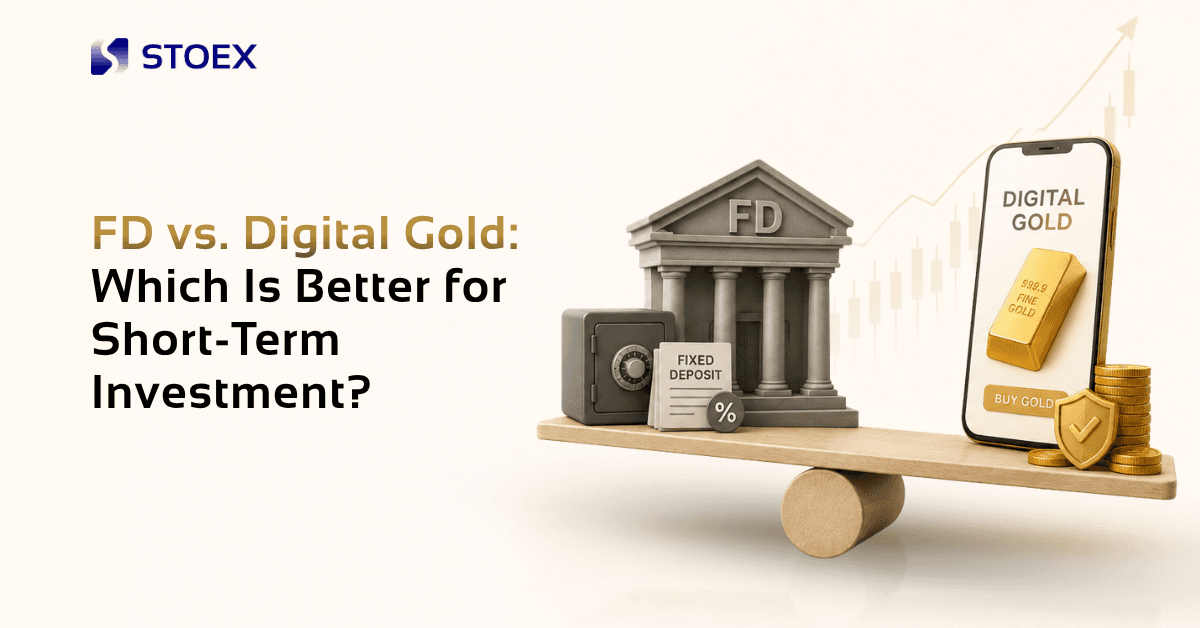
FDs offer fixed returns and greater certainty, while digital gold offers the potential to benefit from rising gold prices and diversify your portfolio. The better choice depends on your goal, risk tolerance and how much certainty you need from your investment.
FD vs. Digital Gold: Both fixed deposits and digital gold can be used for short-term investing, but they offer very different levels of predictability. An FD gives you a fixed interest rate for a defined period, while the value of digital gold moves with the price of gold.
With bank term-deposit rates currently around 6.00%–6.75% and gold remaining market-linked, the choice isn’t as simple as comparing headline returns.
So, which one is better for a short-term investment? Let’s compare FD vs. gold based on returns, risk, liquidity and costs to help you decide where to put your money.
FD vs Digital Gold: Which One Fits a 3–5 Year Goal?
For most short-term goals, FD offers greater predictability. Digital gold, on the other hand, offers the opportunity to earn higher returns if gold prices rise, but the final value will depend on the price when you sell.
The choice between the two comes down to how much return you want, how much risk you can take, and how certain you need the final value of your investment to be

When is an FD a better choice?
An FD is generally a better fit when you have a fixed financial goal and know when you will need the money.
For example, if you need ₹5 lakh three years from now for a planned expense, an FD may be a better fit because you can estimate the maturity value upfront.
When can digital gold be a better choice?
Digital gold may suit you better if you are comfortable with gold-price fluctuations and do not need a fixed amount at a specific date.
Gold has historically delivered long-term returns and can help diversify a portfolio, particularly during periods of market stress.
The World Gold Council’s 2026 research found that adding 7.5%–15% gold to a hypothetical portfolio improved historical risk-adjusted returns and reduced drawdowns over 19 years. But that supports gold as a portfolio diversifier, not as a guaranteed five-year return.
So if your financial goals are flexible and you can tolerate gold price volatility, digital gold can be attractive because it gives you the potential to benefit from rising gold prices while also adding diversification to your portfolio.
FD vs Digital Gold: What Will Actually Affect Your Returns?
At first glance, the comparison seems easy: check the FD interest rate, look at gold’s recent returns, and pick the one with the bigger number.
But that’s not quite how it works.
With an FD
Even though FD offers fixed returns, there are two things to keep in mind:
- Tax: FD interest is taxable, so your actual return will depend on your tax bracket.
- Early withdrawal: Breaking the FD before maturity can reduce the interest you earn, depending on the bank’s terms. RBI rules require banks to have a premature-withdrawal policy and disclose it to depositors.
Eligible bank deposits are also covered by DICGC insurance up to ₹5 lakh per depositor per bank, including principal and interest, subject to the applicable rules.
With digital gold
Here, the final number is less predictable because it depends on gold prices when you sell. That’s where both gold price returns and digital gold risks come into the picture.
And there are a few costs between buying and selling that can affect your return:
- 3% GST on the purchase
- The platform’s buy-sell spread
- Any applicable delivery, custody or other platform charges
- Taxes when you eventually sell
Don’t just compare FD returns vs gold based on returns. You also need to consider the costs, structure and risks behind each investment.
Instead, ask: “After all the costs and taxes, how much am I likely to have when I need it, and can I verify what I own?”
FD vs Digital Gold Returns: A ₹1 Lakh Example
Let’s make this practical. Suppose you have ₹1 lakh today and you want to invest for three years.
For FD vs Digital Gold illustration, assume:
- FD interest rate: 6.5%
- Digital gold purchase: 3% GST
- Digital gold selling spread: 3% for illustration only
- Gold scenarios: +12%, +8%, 0% or -5% annual price movement
- Tax is excluded from the calculation so we can see the difference in the investment mechanics clearly
The 6.5% FD assumption is within the RBI’s current broad term-deposit range above one year. It is an illustration, not a recommendation for any particular bank.
If you put ₹1 lakh into an FD
At 6.5% annual interest compounded quarterly, ₹1 lakh would grow to roughly ₹1.21 lakh over three years, before tax.
That is the useful part of an FD for a goal: you can calculate the destination reasonably well before you start.
If you put ₹1 lakh into digital gold
Because 3% GST is charged on the purchase, the amount attributable to the gold itself is lower than your total cash outlay. Now consider different gold-price outcomes:

*Illustrative calculation assumes ₹1 lakh total outlay including 3% GST and a 3% selling spread. Actual digital-gold pricing, spreads and other charges vary by provider. Figures are before capital-gains tax and are intended only to show how different gold-price outcomes can affect the final amount.
And this is where the difference between the two becomes clearer.
Gold can outperform the FD when prices rise strongly, while an FD’s return remains limited to its agreed interest rate regardless of how gold performs. The trade-off is that gold’s final value cannot be known upfront.
FD vs Digital Gold: Which One Should You Choose for Your Goal?
By now, the difference is fairly simple: an FD gives you more certainty; digital gold gives you exposure to gold’s potential upside along with its price risk.
So, start with your goal, not the asset.
An FD may be the better fit if:
- You need a specific amount on a specific date.
- Your goal is around three years away.
- A fall in your investment just before the goal would create a problem.
- You would rather know your approximate outcome than take a chance on higher returns.
If you’re looking for the best investment for 3 years, start with the goal rather than the asset. A fixed-date goal generally gives you less room to take market-linked risk.
Digital gold may have a role if:
- You want the potential for higher returns if gold prices continue to rise.
- You are comfortable with gold-price fluctuations.
- Your goal has some flexibility around the final amount you receive.
- You want to diversify your portfolio with gold.
Gold offers a different return profile from an FD. Its value can rise significantly when gold prices increase, while also providing diversification benefits.
SEBI-registered investment adviser and CFP Naveen Rego describes gold as a “store of value and a hedge against uncertainty, not as a vehicle for quick profits.” He also writes about maintaining a 5–10% gold allocation as a portfolio diversifier rather than trying to predict gold’s next move.
FD vs Digital Gold: 4 Things to Check Before You Choose
SEBI’s November 2025 caution says digital-gold products offered by online platforms operate outside its regulatory framework and may involve counterparty and operational risks.
So, before you invest in digital gold, make sure to verify these details thoroughly:
1. Who holds your gold?
Find out who is responsible for storing the physical gold and where it is held. The app you buy through may not be the entity that actually stores your gold.
2. Can you verify the physical backing?
Look for independent audits or other evidence that the gold you own is actually backed by physical metal. A platform saying it holds your gold is one thing; being able to verify that backing is another.
3. What happens if the platform stops operating?
Understand how your ownership is recorded and what happens to your gold if the platform or intermediary is no longer around. Your ability to access your gold shouldn’t depend on simply trusting an app.
4. What will you actually pay?
Check the full cost of buying and selling, not just the gold price. Look at GST, the buy-sell spread, and any applicable custody, delivery or redemption charges.
STOEX is built around these areas of transparency. Your digital gold is backed by physical gold, with the gold stored in insured vaults and independently audited reserves. The platform also provides verifiable ownership records and uses independent trustee custody.
This gives greater visibility into how your digital-gold investment works, where it is stored, and who safeguards it, who verifies it, and how ownership is recorded.
If you’re considering digital gold for your portfolio, explore STOEX and invest in digital gold with greater transparency and visibility into your holdings.
FD vs Digital Gold: Choose for the Goal, Not the Return
For a fixed three-year goal, an FD may be better suited if you need certainty about the amount you’ll receive. Digital gold may be more attractive if you are comfortable with market-linked returns and want the potential benefit of rising gold prices.
The choice comes down to what you want your money to do and how much uncertainty you are comfortable with.
If you choose digital gold, look beyond the gold price. Check what you own, where it’s held, how it’s verified and what it costs. That’s the transparency STOEX aims to bring to gold investing.
For a fixed short-term goal, an FD’s predictability can matter more than the possibility of higher returns from gold. If you choose digital gold, make sure you understand the price risk, costs and structure of the product you are buying.
FAQs

Stay Updated with STOEX Insights
Get the latest insights on digital gold, trusteeship, tokenization, and wealth infrastructure directly in your inbox.