
Digital Gold vs Physical Gold: What Should You Buy in 2026?
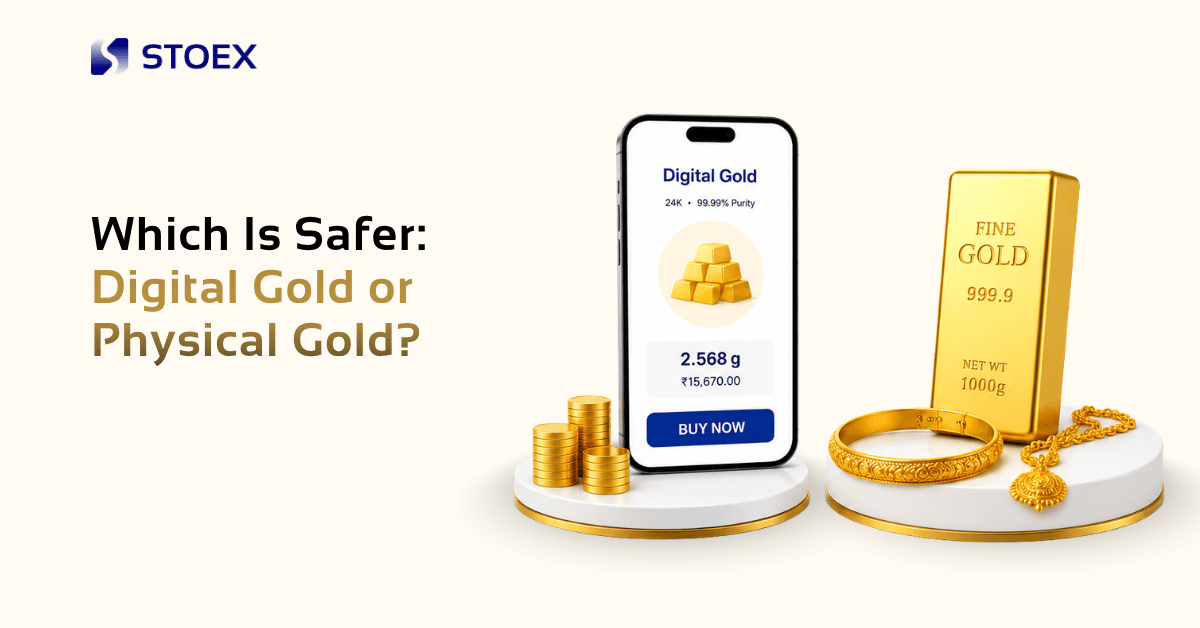
For investment alone, jewellery is usually the least cost-efficient form of gold because you also pay making and design charges that may not be recovered when you sell. Coins and bars give you direct physical ownership but involve premiums and storage. Digital gold is easier to buy in small amounts and store, but you need to check the buy-sell spread, custody, physical backing and platform risk.
Choose jewellery if you want to wear or gift the gold, coins or bars if physical possession matters, and digital gold if convenient accumulation matters more.
For generations, Indians have bought gold for a mix of reasons: to mark weddings and festivals, preserve family wealth, prepare for emergencies and pass something valuable on to the next generation. Jewellery has traditionally been the most familiar way to own it, combining financial value with cultural and emotional significance.
But the way people buy precious metals is changing. Alongside jewellery, you can now choose from coins, bars, digital gold, and gold ETFs. Each option offers a different balance of convenience, liquidity, costs, storage and investment value.
This shift is visible in recent buying patterns. In Q1 2026, Indians bought 62 tonnes of gold bars and coins, almost as much as the 66 tonnes bought as jewellery. Investment demand is also spreading across ETFs and digital gold.
That leaves you with more choices than ever. Let’s compare the gold investment options in India and find out the difference between investing in digital gold vs. physical gold.
What Is the Difference Between Digital Gold, Coins and Jewellery?
The same gold can serve very different purposes depending on how you own it. Broadly, your choices come down to digital precious metals, physical coins and bars, or jewellery.
Digital Gold: Convenience and Easy Accumulation
Digital gold lets you buy fractional quantities through an app instead of purchasing an entire coin, bar or piece of jewellery.
The advantages are straightforward:
- Small-ticket purchases
- Easy accumulation
- No personal locker or storage requirement
- Digital access to your holding
- Potentially easy buying and selling
But it is crucial to know about digital gold safety: Who holds the physical metal? Is it actually backed by physical gold? Is there independent auditing? Is your holding allocated or pooled? What does it cost to buy and sell?
This matters especially for digital gold because in November 2025, SEBI clarified that digital gold products offered by online platforms are outside its regulatory framework and can expose investors to counterparty and operational risks.
As Stoex CEO Sudeep Chatterjee puts it, “Ownership clarity, custody, audits, and redemption matter more than convenience.” That is a useful standard for evaluating any digital gold platform.
Gold Coins or Bars: Physical Ownership
Coins and bars are the more direct route to physical ownership. When you buy gold coins, you own the metal itself and take responsibility for keeping it safe.
They may suit you if you:
- Want tangible ownership
- Prefer to hold the metal yourself
- Plan to keep it for the long term
- Are comfortable with storage and security
The costs don’t end at the purchase price, though. GST, minting or dealer premiums, storage and the eventual resale price can all affect your returns.
Jewellery: When Gold Has a Purpose Beyond Investment
Jewellery serves a different purpose. A necklace bought for a wedding, bangles gifted to a daughter or a ring worn every day carries value beyond its gold content.
But that craftsmanship comes at a cost. Gold making charges, design premiums and resale deductions can mean the amount you receive when selling is different from what you originally paid.
Digital vs Physical Gold: Key Differences
The biggest difference is not simply whether you can see the gold. It is how you own it, what you pay to hold it, and how you verify it.

Which Costs More: Digital Gold, Coins or Jewellery?
The price of gold is only one part of the equation. The real cost is what you pay to buy, what it costs to hold, and what you give up when you sell.
Jewellery: You Pay for the Metal and the Craftsmanship
When you buy jewellery, your bill can include:
- Making charges: These pay for design and craftsmanship and vary by jeweller and design.
- GST: CBIC clarifies that GST on jewellery is 3% of the total transaction value, whether making charges are shown separately or not.
- Resale deductions: When you sell gold jewellery, the original making charges and design premium may not be recovered in full. The buyer generally values the recoverable metal rather than the craftsmanship you originally paid for.
For example, if the gold component of a piece is ₹1 lakh and the jeweller adds ₹15,000 as making charges, the purchase price is already ₹1.15 lakh before the 3% GST on the transaction value.
So when evaluating gold investment costs in India, don’t compare a jewellery bill only with the day’s gold rate. Consider the gold resale value too: compare the total amount you paid with what you can realistically recover later.
Coins and Bars: Fewer Charges, But Storage Still Counts
Gold coins and bars remove the biggest cost associated with jewellery: craftsmanship.
But they still come with costs such as:
- GST: Physical gold purchases attract 3% GST.
- Premiums: Coins and bars can carry minting, packaging or dealer premiums over the underlying metal price.
- Storage: A bank locker or secure home storage adds an ongoing cost that doesn’t appear on the purchase invoice.
- Resale spread: The price a dealer is willing to pay when you sell may be below the prevailing market price.
So a ₹50,000 coin is not necessarily ₹50,000 worth of gold. Part of the amount may represent GST and the premium attached to the physical product. Same goes for silver coins and silver bars: compare the metal value with the final purchase price before you buy.
Digital Gold: Check the Buy-Sell Gap
Digital gold and silver remove the need for you to store the metal yourself, but they introduce a different set of costs.
- GST: Digital gold purchases attract 3% GST.
- Buy-sell spread: The platform’s buy price can be higher than its sell price. That difference affects your return even if the underlying gold price hasn’t moved. The spread varies by platform and market conditions, so check both prices before investing.
- Delivery charges: If you convert your digital holding into physical coins or bars, delivery and other applicable charges may apply.
- Custody and storage: The physical metal is held by a custodian rather than by you. Depending on the platform, storage, insurance and related costs may be charged separately or reflected in the pricing structure.
These digital gold hidden fees can be easy to overlook. Compare the platform’s buy and sell prices to understand the digital gold buy-sell spread, and check for delivery or custody charges.
Which Is Safer: Digital Gold or Physical Gold?
Cost tells you what you paid. Verification tells you what you actually own. And this is where digital and physical gold differ most clearly.
With Physical Gold, Check What You’re Holding
If you’re wondering how to verify gold purity in India, BIS hallmarking is one of the key checks for hallmarked jewellery. A current BIS hallmark consists of the BIS logo, purity/fineness and a six-digit HUID number, which can be verified through the BIS Care App.
Before buying physical gold, check:
- Hallmark: Look for the BIS hallmark and HUID on applicable hallmarked jewellery.
- Purity: Check the stated caratage and fineness—for example, 22K (916).
- Weight: Your bill should clearly state the net weight of the precious metal.
- Invoice: BIS recommends taking an authentic invoice. It should include details such as the article, net precious-metal weight, purity and fineness.
- Seller/refiner: Check who manufactured or supplied the metal and whether the seller is appropriately registered.
BIS also allows consumers to have jewellery or samples tested at recognised Assaying and Hallmarking Centres if they want independent purity verification.
With Digital Gold, Check What Sits Behind the App
With digital gold, you don’t physically hold the metal. So before investing, ask:
- Is the gold physically backed? What physical metal corresponds to your digital holding?
- Who holds it? Is custody with the platform, a third-party custodian or an independent trustee?
- Where is it stored? Is the vault identified, insured and subject to independent checks?
- Is there independent auditing? Can you access evidence that the physical gold matches the holdings represented digitally?
- Can you verify your holding? Is there a record you can independently check rather than relying only on an app balance?
- What happens if the platform stops operating? Understand the custody, redemption and recovery process before you invest.
This is why transparency matters when choosing a digital gold platform. You should be able to understand where your gold is stored, what backs your holding and how you can verify it. That is the standard Stoex is built around, with independently auditable holdings and a tamper-proof record that lets you verify your ownership.
Which Is Easier to Sell: Digital Gold, Coins or Jewellery?
How easily you can sell gold depends on both liquidity and resale value. Liquidity tells you how quickly you can sell. Resale value tells you how much of your original purchase price you can recover.
Digital Gold
Digital gold can usually be sold through the same platform where you bought them, subject to the provider’s terms. The main thing to check is the buy-sell spread.
Gold Coins or Bars
Coins and bars can be sold to jewellers, dealers or other buyers. The resale price depends on purity, seller policies and prevailing market rates. You may not recover the premium you paid for minting, packaging or branding. Some buyers may offer less than the prevailing market price.
Jewellery
Jewellery is widely accepted for resale or exchange, but that does not necessarily mean it offers the best resale value.
Buyer generally values the recoverable gold rather than the amount you originally paid for design and craftsmanship. Making charges and design premiums are therefore unlikely to be recovered in full. Additional deductions may apply depending on the jeweller and the condition or purity of the piece.
So if resale flexibility is important, look beyond how easy an asset is to sell. Compare the price you pay today with the amount you are likely to receive when you exit.
So, What Should You Buy?
There isn’t one best way to invest in gold. The right choice depends on why you’re buying it in the first place.
Choose Digital Gold If You Want Convenience
Digital gold may suit you if you want to start small and build your holding over time.
It can make sense when you:
- Want to make small, regular purchases
- Prefer to accumulate gradually
- Don’t want to manage physical storage
- Want to buy, track and sell through an app
However, you have to check the buy-sell spread, custody structure, physical backing and how you can verify your holding before choosing a platform.
Choose Coins or Bars If You Want Physical Ownership
Coins and bars are a straightforward choice when you want the metal in your possession.
They may suit you if you:
- Want a tangible asset you can physically hold
- Plan to keep your gold for the long term
- Prefer direct control over storage and security
Before buying, compare the purity, premium over the metal price, seller credentials and resale terms.
Choose Jewellery If Jewellery Is the Goal
If you’re buying gold for a wedding, a family occasion or to wear, jewellery can be the right choice.
It makes sense when your priority is:
- Wearing it
- Weddings and celebrations
- Gifting
- Family or cultural traditions
Remember jewelry is more than a gold investment. You’re paying for the metal as well as the craftsmanship, design and convenience of having it made into something you can use.
Gold Has Many Forms. Which One Is Right for You?
There is no universal winner between digital gold, physical gold and jewellery. Each solves a different need: digital gold makes accumulation convenient, coins and bars offer direct physical ownership, while jewellery brings together gold, craftsmanship and tradition.
The smarter choice is the one that fits your purpose and whose costs and ownership structure you understand before buying. That is also the principle behind Stoex: make gold ownership easier to understand, easier to verify and less dependent on guesswork.
Because the best way to invest in gold isn’t simply to choose the most convenient option. It’s to know exactly what you’re buying.
FAQs

Stay Updated with STOEX Insights
Get the latest insights on digital gold, trusteeship, tokenization, and wealth infrastructure directly in your inbox.