
Digital Gold SIP vs Mutual Fund SIP: Which Is Better in 2026?
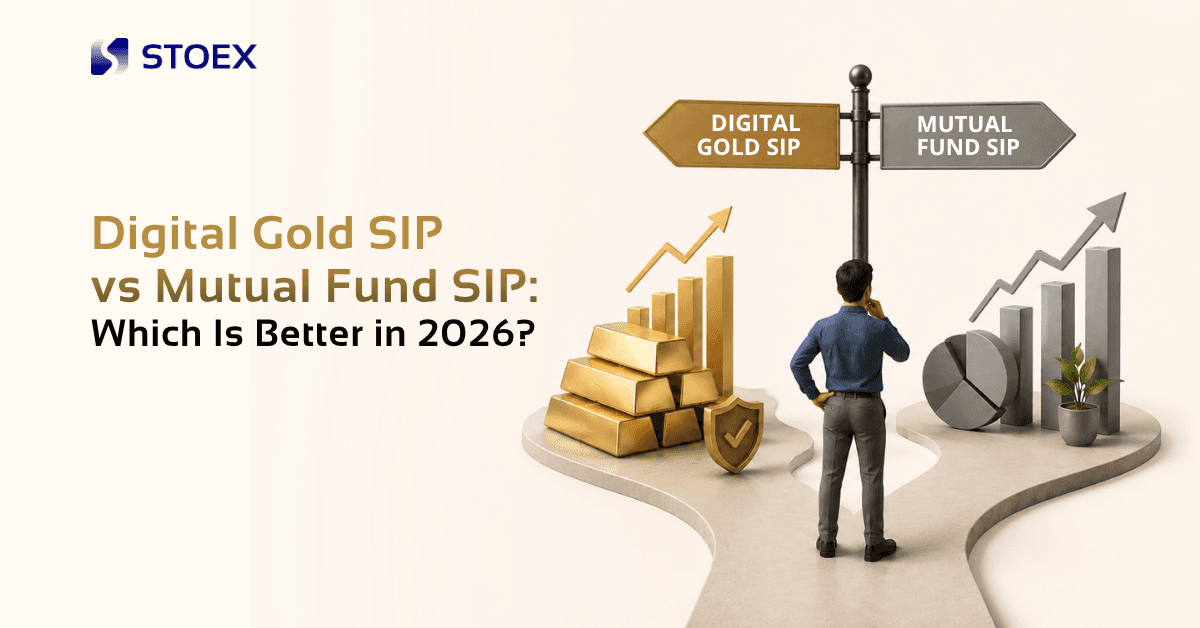
An equity mutual fund SIP is generally better suited to long-term wealth creation, while a digital gold SIP is better suited to building gold exposure and portfolio diversification.
Equity carries market risk; digital gold carries gold-price risk along with platform and custody considerations. The right choice depends on your goal, time horizon and portfolio needs.
Digital gold vs Mutual fund: ₹5,000 a month into each may look like the same investment strategy, but they work very differently.₹5,000 a month into digital gold and ₹5,000 a month into an equity mutual fund may look like the same investment strategy, but they work very differently.
With digital gold, your money tracks the value of gold. With an equity mutual fund, it is invested across businesses with the aim of generating long-term returns. So, while the amount invested is the same, the returns, risks and underlying investments are different.
So before deciding between digital gold vs mutual fund, ask a simpler question: What do you want this money to do? What do you want this money to do—build wealth, diversify your portfolio, or give you exposure to gold?
Digital Gold vs Mutual Fund: What Is a Mutual Fund SIP?
A mutual fund SIP (Systematic Investment Plan) lets you invest a fixed amount in a mutual fund at regular intervals, usually monthly. For this comparison, we’re specifically looking at equity mutual fund SIPs, where your money buys units of a fund that invests primarily in stocks.
The value of these units rises or falls with the fund’s underlying investments, making equity mutual funds a market-linked investment typically used for long-term wealth creation.
And the habit is clearly catching on. SIP contributions reached ₹31,961 crore in July 2026, according to AMFI.
Digital Gold vs Mutual Fund: What Is a Digital Gold SIP?
A digital gold SIP lets you buy small amounts of gold at regular intervals through a digital gold platform. Instead of making a large lump-sum purchase, you accumulate fractional gold over time.
Despite the name, a digital gold SIP is not the same type of SIP used for mutual funds. It is essentially an automated recurring gold investment: at each interval, your chosen amount is used to buy digital gold at the prevailing price.
The gold you purchase is backed by physical gold stored by the provider or its custodian, and the quantity you accumulate depends on the gold price at the time of each purchase.
Digital Gold SIP vs Mutual Fund SIP: Which Is Better?
At first glance, digital gold and mutual fund SIPs can feel similar: choose an amount, invest regularly and track the value online. But the similarity largely ends there.
As STOEX CEO Sudeep Chatterjee puts it, investors often compare investments on “convenience and returns” without looking closely at what they actually own.
With digital gold, your money buys an interest in physical gold held on your behalf. With an equity mutual fund, you own units of a fund whose portfolio is primarily invested in shares of companies.
That difference in the underlying asset shapes almost everything that follows: returns, risk, costs and the role each investment can play in your portfolio.

Digital Gold vs Mutual Fund: Comparing Returns
An equity mutual fund earns returns based on the performance of the companies it invests in. As these businesses grow, their earnings and valuations can increase, pushing up the value of the fund.
Digital gold works differently. It does not generate earnings or pay dividends. Your returns depend on whether the price of gold rises after you invest. It is influenced by factors such as inflation, interest rates, currency movements, central-bank demand and global uncertainty.
This does not mean gold cannot outperform equities. The World Gold Council’s 2026 research shows that gold was one of the strongest-performing major assets for Indian investors in 2025 and early 2026 .However, gold is generally held for a different reason: diversification and protection during periods when other assets may struggle.
Kalpen Parekh, MD & CEO of DSP Mutual Fund, made a similar point at the Moneycontrol Global Wealth Summit in March 2026. He noted that gold had outperformed Indian equities only about 25% of the time on a rolling five-year basis, supporting the case for treating gold primarily as a diversifier rather than a growth engine.
Suppose you invest ₹5,000 every month for 10 years. You would invest a total of ₹6 lakh.
The final corpus depends on the return generated by the underlying asset, not on the fact that both investments use a SIP.
For illustration:
- At an average annualised return of 8%: about ₹9.15 lakh
- At 12%: about ₹11.50 lakh
Same SIP, different assets, and a very different potential outcome. These figures are hypothetical, not forecasts. Gold and equity can both go through periods of weak performance, and equity can be considerably more volatile along the way.
Past performance can tell you what happened. It can’t tell you what will happen next. The important question is whether the asset fits your goal and investment horizon.
Digital Gold vs Mutual Fund: Which Carries More Risk?
Neither is risk-free, but the risks come from different places.
An equity mutual fund SIP is exposed to the stock market. Its value can fall sharply during corrections, and while a longer holding period can help you ride through short-term volatility, it does not guarantee returns or eliminate the possibility of loss.
With a digital gold SIP, your investment moves with gold prices, which can also rise and fall. But there is an additional layer to consider: how the gold is held and how your ownership is structured. Who has custody? How is your holding recorded? How does redemption work? What happens if the platform stops operating?
This is where SEBI’s warning on digital gold matters. Digital gold does not fall under the same regulatory and investor-protection framework as mutual funds, so you need to look beyond the gold price and understand the structure behind the investment.
So, is digital gold safer than a mutual fund SIP? Not necessarily; the risks are simply different. An equity SIP primarily carries market risk; digital gold carries gold-price risk along with platform and custody considerations.
That’s why the better question is: do you understand what you’re exposed to, and can you verify what you own? Platforms such as STOEX take this approach by making transparency, ownership and the underlying gold easier to verify.
Digital Gold vs Mutual Fund: What Does a ₹5,000 SIP Cost?
The costs of investing ₹5,000 every month differ significantly between digital gold and mutual funds. With digital gold, some costs apply when you buy or sell. With mutual funds, costs are largely built into the fund and reflected in its NAV.
Digital gold: look beyond the gold price
When comparing digital gold charges, keep an eye on three things:
1.GST
A 3% GST applies to the purchase of digital gold. That means GST is part of the upfront cost you need to account for when comparing digital gold with other gold investment options.
2. Buy-sell spread
The price you pay to buy gold can be higher than the price you receive when you sell it. This gold buy-sell spread is a cost that can reduce your realised return, particularly over shorter holding periods.
Before starting a digital gold SIP, check both the buy price and the sell price, not just the live gold price.
3. Other charges
Depending on the provider, you may also encounter charges related to storage, custody or physical delivery.
So, for a ₹5,000 digital gold SIP, don’t look only at how many grams you receive. Check what you pay to buy and what you would receive if you sold.
Mutual fund SIP: the costs are different
For an equity mutual fund SIP, the main ongoing cost is the expense ratio—the fee charged by the fund for managing the scheme. Because this cost is reflected in the NAV, it ultimately affects your mutual fund returns.
Two other things matter:
- Direct vs regular plans: Direct plans generally have lower expense ratios because they don’t include distributor commissions.
- Exit load: Some funds charge a fee if you redeem within a specified period.
Taxes can also affect your final returns, but the tax treatment depends on the fund and your circumstances, so it is better considered separately from the basic cost comparison.
So don’t compare digital gold vs mutual fund on their headline charges alone. Look at what you pay to buy, what it costs to hold, and what you get when you sell or redeem.
Digital Gold SIP or Mutual Fund SIP: Which Should You Choose?
Choose a mutual fund SIP if you want:
- Long-term wealth creation, especially if you want to invest for 7–10+ years
- Exposure to businesses and India’s economic growth
- Higher long-term growth potential, if you’re comfortable with market volatility
- A SIP investment approach that helps you invest consistently through different market cycles
Consider a digital gold SIP if you want:
- Gold exposure without buying or storing physical bars or coins
- Portfolio diversification beyond equities
- An asset whose price can behave differently from stocks
- To accumulate gold gradually through small, regular purchases
The Better SIP Is the One That Fits Your Goal
A digital gold SIP and an equity mutual fund SIP may look similar on the surface, but they serve different purposes. An equity mutual fund SIP is generally better suited to long-term wealth creation, while a digital gold SIP can help build gold exposure and add portfolio diversification.
The choice comes down to more than returns. Look at the asset underneath, the costs involved, the risks you are taking and, with digital gold, whether you can verify what you own.
If digital gold fits your goals, you can start building your gold investment with STOEX, with transparent ownership and verifiable holdings.
FAQs

Stay Updated with STOEX Insights
Get the latest insights on digital gold, trusteeship, tokenization, and wealth infrastructure directly in your inbox.