


Can Gold Be Part of Your Emergency Fund?
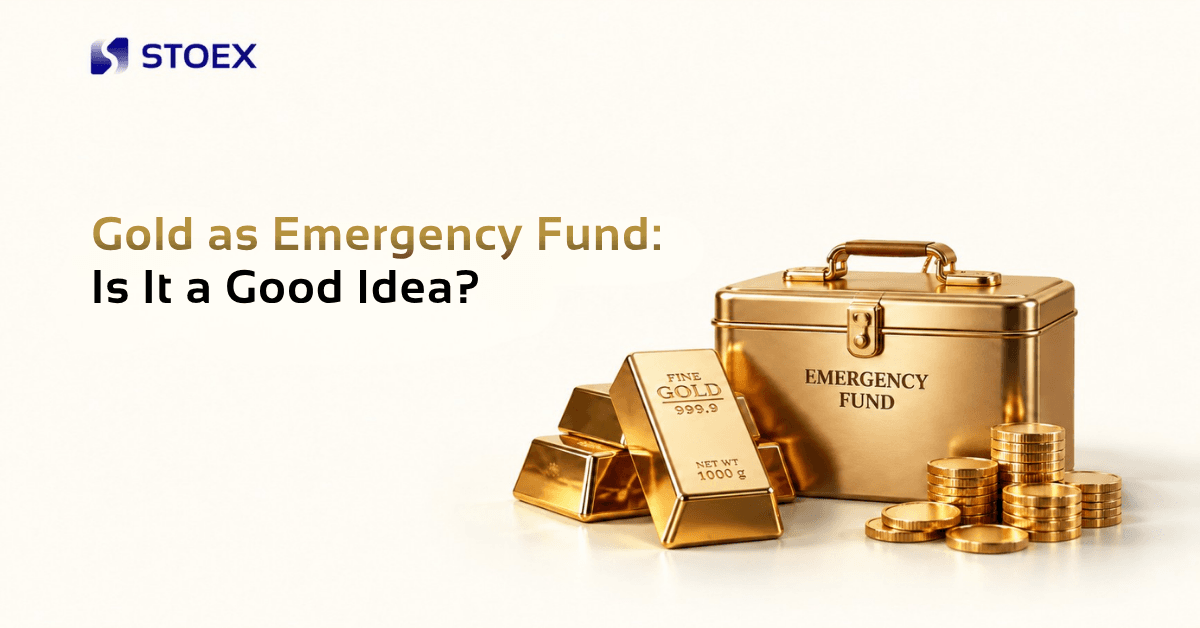
Gold as an emergency fund can work as a secondary layer of financial backup, but it should not normally replace readily accessible savings. An emergency fund in gold can be sold or pledged when needed, but gold prices can fluctuate and the time and cost involved in converting it to cash depend on the type of gold you hold.
For most people, the core emergency savings should cover around 3–6 months of essential expenses, with gold kept as an additional financial safety net.
Gold is easy to recognise, widely accepted and generally easy to sell. That makes it seem like a natural emergency fund. But being sellable is not the same as being immediately available or price-stable.
An emergency fund usually covers 3 to 6 months of essential expenses. Its job is to give you predictable access to money when you need it, not to maximise investment returns. Gold prices can move, physical gold may involve purity checks and resale deductions, and products such as ETFs or Sovereign Gold Bonds follow different exit processes.
So, can gold be an emergency fund? Yes, but usually as a second layer of financial backup rather than a replacement for cash.
Here’s where gold for emergency savings can fit, how gold vs cash for an emergency fund compares, and what changes when you use an FD, ETF, digital gold or physical gold instead.
What Does an Emergency Fund Need?
An emergency fund has a simple job: be there when you need it. That makes liquidity more important than chasing returns.
Before considering gold for emergency savings, look at three things:
1. Liquidity
You should be able to access the money quickly when an emergency happens. For example, your car breaks down today, you shouldn’t have to wait for a buyer to purchase your asset before paying the repair bill.
2. Capital stability
Your emergency savings shouldn’t be heavily exposed to market movements. The worst time to discover that an asset has fallen 15% is when you urgently need to sell it.
3. Accessibility
The money should be easy to withdraw or use. It shouldn’t depend on finding a buyer, arranging physical delivery or completing a lengthy redemption process.

That is why financial guidance commonly starts with 3–6 months of essential expenses. Finance experts recommend this range and emphasize keeping the money in easily accessible options. The exact amount can be higher or lower depending on factors such as income stability, dependents and liabilities.
Can Gold Be Part of Your Emergency Fund?
Yes, but gold in an emergency fund works better as a secondary layer than as the first one. It can make sense when:
- You already own physical gold, such as gold jewellery or gold coins;
- Your core emergency savings are already adequately funded;
- You are comfortable selling or pledging the gold if a larger emergency occurs;
- You want an additional source of liquidity outside your regular bank balance.
This is where a physical gold emergency fund can be useful. If you already own gold, you have an asset that can potentially be sold or pledged without having to build that reserve from scratch.
A gold loan can also provide access to funds against eligible gold, although it is borrowing and comes with its own costs and repayment obligations.
But gold as an emergency fund also comes with a trade-off: it gives you another source of liquidity, but not necessarily the same certainty as a cash reserve.
- Gold prices fluctuate. Gold price volatility means the value of your holdings can be different when you need to sell them.
- The market price isn’t always your sale price. Purity checks, dealer margins and deductions can affect the amount you receive.
- Jewellery may involve resale deductions. Making charges generally aren’t recovered, and the final offer depends on the item and buyer.
- Access depends on the form of gold. Selling a gold ETF, selling digital gold, or selling physical gold are different processes, with different timelines and costs.
Why Gold Shouldn’t Replace Your Liquid Emergency Fund
Cash already sits within your financial system and can usually be accessed without first finding a buyer or deciding whether the market price is right.
Imagine an unexpected hospital bill due today. You don’t just need an asset that can be sold, you need money you can access without worrying about its value or how quickly the transaction will go.
That’s where gold has a few limitations.
You may need the money immediately
Selling physical gold can involve finding a buyer, checking purity and completing the transaction. Even a gold investment that can be sold electronically may still require a market transaction and settlement. An emergency fund should ideally be simpler than that.
You can’t control the gold price
Gold can be a valuable asset, but its market price changes. In 2026, the World Gold Council reported that gold’s 30-day realised volatility briefly rose above 50% during the first half of the year before falling below 30% by late June.
If you need to sell during a price decline, the amount you receive may be lower than expected.
Selling can involve friction
The price you see for gold isn’t necessarily the amount you will receive. Physical gold can involve resale deductions, while jewellery may not recover the making charges paid at purchase.
And not all gold investments are equally liquid
A gold ETF, digital gold, physical gold and Sovereign Gold Bond can all give you exposure to gold, but the process of turning each into usable money is different.
So, gold can provide a backup source of liquidity, but it doesn’t offer the same kind of predictability as money kept specifically for immediate expenses. That is why the core of an emergency fund is usually better kept in readily accessible options, with gold playing a different role.
Does the Type of Gold Matter?
Yes. “Gold” isn’t one single emergency asset. How quickly you can turn it into usable money depends on the form you hold.
A gold coin sitting in your locker, a Gold ETF in your demat account and an SGB may all track gold in different ways, but their exit processes are not the same.
| Gold form | Emergency use |
|---|---|
| Physical gold | Can be sold or pledged, but access and resale value can vary |
| Gold ETF | Can be sold through the market, but still requires a transaction |
| Digital gold | Can be sold through the platform, subject to its terms |
| SGB | Less suited to immediate emergencies because its exit depends on its structure and available market liquidity |
Gold ETFs do have an important liquidity advantage over physical gold: SEBI notes that ETFs trade on stock exchanges and can generally be bought and sold with flexibility.
But that still makes them an investment that can be liquidated, not the same thing as money already sitting in your bank account.
A Simple Way to Think About Gold in Your Emergency Plan
Think of your emergency fund in layers, rather than putting everything into one asset. For example, if your essential expenses are ₹50,000 a month, a six-month emergency fund would be ₹3 lakh.
You could keep the first layer in readily accessible options such as a savings account or other liquid instruments. Gold can then sit outside this core reserve as an additional backup, something you could sell or pledge if a larger emergency stretches beyond your readily available cash.
So, Where Does Gold Fit?
The answer depends on when you need the money and how quickly you need to access it. Gold can have a place in your financial safety net, but its role changes depending on the situation.
| If you need… | Gold’s role | Money today |
|---|---|---|
| Not the first choice | Several months of emergency expenses | Liquid savings, FD and similar options should form the core |
| Additional financial backup | Gold can play a supporting role | — |
| Long-term wealth protection | Gold can be considered as part of an investment portfolio | — |
Gold Has a Role. Your Emergency Fund Has a Different Job.
Gold can be sold, pledged and used to raise money when you need it. That makes it a useful part of a broader financial safety net, especially if you already own it.
But an emergency fund has a different job. It needs to be available when an unexpected bill arrives, without making you depend on the gold price, find a buyer or navigate an exit process.
As STOEX Founder & CEO Sudeep Chatterjee puts it: “Emergency fund is not investment money. Separate what needs to stay liquid first.”
So, think of gold as an emergency fund as a backup layer, not necessarily the foundation. Keep your immediate emergency savings accessible, and let gold play the longer-term role of an additional financial cushion.
Frequently Asked Questions

Stay updated with Stoex insights
Get the latest insights on 24K vaulted gold, trusteeship, tokenization, and wealth infrastructure directly in your inbox.